Guide 04 of 15
A free English pronunciation course you can follow at home
If you want clearer English pronunciation but paid classes are expensive and free videos jump around without a plan, this free course gives you what a good paid one does: the right topics in the right order, with practice and a way to check progress.
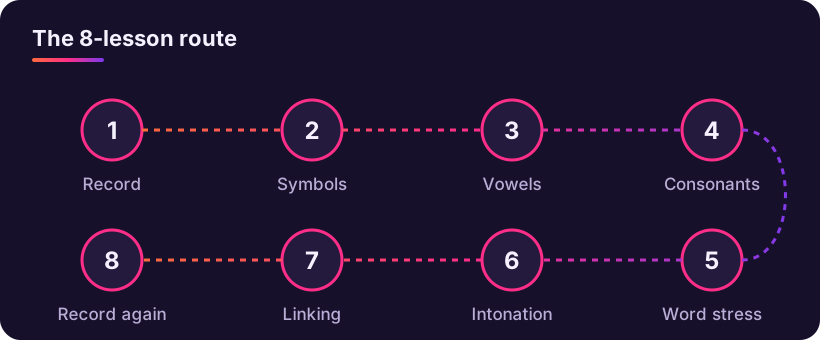
Here is that course, free and self-paced, in eight lessons. It uses the guides and word pages on this site, and it takes about four weeks at 20 minutes a day.
The eight lessons
Lesson 1: record where you start
Before you learn anything, record yourself reading a short paragraph aloud, and save the file. You'll record the same paragraph at the end of lesson 8. Hearing the two side by side is the most honest progress report you'll get.
While you listen back, note which words felt unsure. Those are your first practice words.
Lesson 2: learn the sound symbols
Dictionaries write sounds with symbols, and once you can read them, every dictionary becomes a pronunciation teacher. Work through the pronunciation symbols guide and play each example word. Don't memorize the chart in one go; come back to it during every later lesson.
Lesson 3: vowels
Vowels carry most of an accent. Focus on the pairs English depends on, and that many other languages don't separate:
| Pair | Listen for |
|---|---|
| ship /ˈʃɪp/ / sheep /ˈʃip/ | short ɪ against long i |
| bed /ˈbɛd/ / bad /ˈbæd/ | ɛ against the wider æ |
| cup /ˈkʌp/ / cop /ˈkɑp/ | ʌ against ɑ |
| full /ˈfʊl/ / fool /ˈful/ | short ʊ against long u |
Then practice the vowel that matters most of all, schwa, the light "uh" in unstressed syllables, as in salmon /ˈsæmən/.
Lesson 4: consonants
Work on the sounds that cause the most misunderstandings: th in three /θɹiː/ and that /ˈðæt/, r against l (right /ˈɹaɪt/ and light /ˈlaɪt/), and v against b (very /ˈvɛ.ɹi/ and berry /ˈbɛ.ɹi/). Then practice final consonants and clusters. English words often end in two or three consonants, as in text /tɛkst/, and every one of them should be heard.
Lesson 5: word stress
A wrong stress makes a word harder to recognize than an imperfect vowel does. Learn where the strong beat falls in important /ɪmˈpɔɹ.tənt/ and detergent /dɪˈtɝd͡ʒənt/ (the second syllable) and in library /ˈlaɪˌbɹɛɹ.i/ (the first). Then read the spelling patterns guide, which covers the endings that move stress.
Lesson 6: sentence stress and intonation
In a sentence, the content words (nouns, main verbs, adjectives) are stressed, and the small grammar words are weak and quick. Your voice usually falls at the end of a statement. It often rises at the end of a yes/no question, and it falls on a question /ˈkwɛs.tʃən/ that starts with what, where or how. Read short dialogues aloud and exaggerate the melody at first.
Lesson 7: connected speech
Native speakers link words together. A final consonant runs into a following vowel, and weak words shrink. Practice phrases, not single words: "an apple", "turn it off", "what do you want". Speed comes last. Clear linking at a steady pace sounds more natural than rushing.
Lesson 8: record again
Read the paragraph from lesson 1 again, record it, and compare. Write down three things that improved and three that still feel hard. Those three become your next month's practice.
Choosing an accent model
Pick one model and stay with it, so your ear has a single target. This course uses American English: the r after vowels is pronounced, and you'll hear either /ˈaɪ.ðɚ/ both as "EE-ther" and as "EYE-ther", which are both standard. Many word pages here also give the British form, and on any of them you can switch the voice to British English, so you can hear the difference whenever you're curious.
Your goal is to be understood easily, not to erase your accent. A clear speaker with an accent communicates better than someone who imitates a native accent but swallows half the sounds.
How to practice each day
- 20 minutes, every day, beats two hours once a week.
- Listen, then repeat. Play a word at a slower speed, then say it back at normal speed.
- Use minimal pairs. Two words that differ by one sound train your ear and your mouth together.
- Check yourself. Try the voice check on any word page: say the word and find out whether it was heard the way you meant.
The guide to improving your pronunciation covers these habits in more depth.
Classes, coaches and books: when to pay
A free route like this one works if you're disciplined. Paying makes sense when you need:
- feedback from a trained ear, for sounds you can't hear yourself getting wrong
- accountability, if you won't practice without a fixed appointment
- a certificate for an employer or a course
If you buy a pronunciation book, look for one with audio for every exercise, a sound chart that uses IPA, and units on stress and intonation, not just single sounds. If you're learning from a specific first language, the guide for speakers of other languages shows where to focus.
Using pronunciation at work
Clear pronunciation matters most in the moments you can't repeat yourself easily: phone calls, presentations, meetings. Before an important talk, list the names, numbers and technical words you'll say, check each one in the pronunciation tool, and practice them aloud until they come out without hesitation.
Frequently asked questions
Which are the best books to improve English pronunciation?
The best book is one you will actually work through, built the right way. Look for audio for every exercise, a sound chart written in IPA, and units on word stress and intonation as well as single sounds, and pick one that uses the same accent model you practice, so your ear keeps one target. A book suits you if you're happy to work through exercises on your own. What a book can't do is hear you, so keep recording yourself as in lessons 1 and 8, and if some sounds still seem wrong but you can't tell why, that's the point where feedback from a trained ear is worth paying for.
Is there a free English pronunciation course online?
Yes, this one. It runs in eight self-paced lessons, from a first recording through sound symbols, vowels, consonants, word stress and intonation to connected speech, and it takes about four weeks at 20 minutes a day. The guides and word pages it uses are free.
Do I need pronunciation classes or a coach?
Not to get started. A free, self-paced route works if you practice regularly. Classes or a coach are worth the money when you need a trained ear to catch sounds you can't hear yourself getting wrong, when you won't practice without a fixed appointment, or when an employer or course asks for a certificate.
Pronunciations come from our checked word data. The sources are listed on our Credits page.