
Guide 01 of 15
English pronunciation rules: the patterns that actually help
If English spelling leaves you guessing how to say a word like colonel /ˈkɝnəl/, learn the small set of patterns below, which most words follow, and look up and listen to the few that break them. Spelling and sound stopped matching centuries ago, so no pattern is perfect, but with these you'll pronounce most new words correctly on the first try.
This guide gives you those patterns first, with a playable example for each, then an A–Z summary you can come back to.
Why spelling and sound don't line up
English kept spellings from older forms of the language while the sounds moved on. It also borrowed words from French, Latin, Greek and many other languages, often keeping the original spelling, and scholars later respelled some words to look like their Latin roots. That's why debt /ˈdɛt/ has a b nobody says, and why quay /kiː/ sounds exactly like key /ˈki/. The s in island /ˈaɪ.lənd/ is a respelling of the same kind: it was put in to make the word look like the Latin insula, although the word itself comes from Old English, which had no s there.
So treat the rules below as strong habits, not laws. Each one holds for most words and has a few famous exceptions.
Vowel patterns
Short vowels in short words
A vowel followed by a consonant in a one-syllable word is usually short: bag /bæɡ/, six /sɪks/, text /tɛkst/. The a in bag is æ, the i in six is ɪ, and the e in text is ɛ.
Short u has two sounds, which is why put /ˈpʊt/ and but /ˈbʌt/ don't rhyme. They once had the same vowel. A few hundred years ago, that vowel changed to the open "uh" of but in most words, but it often stayed as it was after p or f, or before l or sh: pull /ˈpʊl/ and push /ˈpʊʃ/ kept it along with put. The change never happened in much of northern England, where put and but still share a vowel.
The silent e makes the vowel say its name
Add a silent e after a single consonant and the vowel before it usually becomes long, saying its letter name. Compare sit /ˈsɪt/ with site /saɪt/, not /ˈnɑt/ with quote /kwoʊt/, and plan /ˈplæn/ with plane /ˈpleɪn/. The final e itself makes no sound, as in vague /veɪɡ/.
That's why use /ˈjus/ and globe /ˈɡloʊb/ have a silent e: each has a vowel, one consonant, then the e. In she /ˈʃi/ there is no vowel before the e, so the e is the word's only vowel and it has to be said. adobe /əˈdoʊ.bi/ looks like globe but was borrowed from Spanish, and English kept its final e as a spoken syllable. When a word comes from another language, the silent-e pattern often doesn't apply.
The prefix bi-, meaning two or twice, also usually says the letter name of i, like "bye", even with no e after it: bicycle /ˈbaɪ.sɪ.kəl/, bilingual /baɪˈlɪŋ.ɡwəl/, biannual /baɪˈæ.nu.əl/. A short i is possible but rare.
Two vowels together
When two vowel letters sit side by side, they often make one sound: ea in meat /ˈmit/, ai in rain /ˈɹeɪn/, oa in boat /ˈboʊt/. This is a tendency with many exceptions. Ea is also the short ɛ of bread /bɹɛd/.
The unstressed vowel, schwa
In longer words, vowels in unstressed syllables usually weaken to a short, relaxed ə, called schwa. It is the most common vowel sound in English. You can hear it in the second syllable of salmon /ˈsæmən/ and in the first syllable of pronunciation /pɹəˌnʌn.siˈeɪ.ʃən/, where the o is spelled but barely said.
R after a vowel
In General American the r is pronounced after vowels, and it colors the vowel before it: four /foɹ/ ends in a clear r, and the yr in zephyr /ˈzɛfɚ/ is a single r-colored vowel, ɚ.
Consonant patterns
Soft and hard c and g
C before e, i or y usually sounds like s (city /ˈsɪ.ti/, cent /ˈsɛnt/). Before other letters it sounds like k (cat /ˈkæt/). G follows the same pattern more loosely. It is often dʒ before e, i or y, as in generator /ˈdʒɛnəɹeɪtə(ɹ)/, but it stays hard in common words like get /ˈɡɛt/ and give /ˈɡɪv/.
-tion and -sion
The ending -tion is almost always ʃən, like the end of nation /ˈneɪ.ʃən/. The stress lands on the syllable just before it: in pronunciation (above), the strong beat is the a of -ation.
A d or t followed by a "you" sound often merges with it, the d into a j sound and the t into ch. So education /ˌɛ.dʒəˈkeɪ.ʃən/ comes out as "edjucation", and that is the normal way to say it, not a mistake. Americans say it with the j, and in Britain both the j and a careful "ed-you" are heard.
The ending can also take the softer zh sound, as in vision /ˈvɪ.ʒən/. Some words are heard both ways: coercion /koʊˈɝ.ʃən/ is said with zh or sh in the US, and with sh in Britain. Neither is wrong. version /ˈvɝ.ʒən/ wavers the same way in Britain.
Th has two sounds
Th is voiceless θ in three /θɹiː/ and voiced ð in that /ˈðæt/. Put your fingers on your throat. You'll feel a buzz for that and none for three.
Silent letters
These letter pairs drop one letter in speech:
| Spelling | Silent letter | Example |
|---|---|---|
| kn- | k | knee /ˈni/ |
| wr- | w | write /ˈɹaɪt/ |
| -mb | b | lamb /ˈlæm/ |
| -bt | b | doubt /ˈdaʊt/ |
| ps- | p | psalm /sɑm/ (the l is silent too) |
| -lm, -lk | l | walk /ˈwɔk/ |
| initial h in some words | h | heir /ˈɛɚ/, hour /ˈaʊ.ɚ/ |
Some silent letters vary by speaker. Many Americans say herb /(h)ɝb/ with no h, and often /ˈɔ.fən/ is heard both with and without its t.
Silent letters usually point back to where a word came from. pneumonia /nuˈmoʊ.njə/ comes from the Greek word for lung, and English usually drops the first sound of Greek clusters like pn and ps, so only the n is said. queue /kju/ is a French spelling, from the French word for tail, and English kept every letter while saying only one sound: the same as the name of the letter q. The u-e-u-e after the q make up that "you" sound between them; none of them is said on its own.
Grammar endings
The -s ending has three sounds
Plural and verb -s endings follow the sound before them:
- after a voiceless sound it is s: tips /tɪps/
- after a voiced sound it is z: labs /ˈlæbz/
- after s, z, sh, ch or j sounds it adds a syllable, ɪz: exercises /ˈɛk.sɚ.saɪ.zɪz/
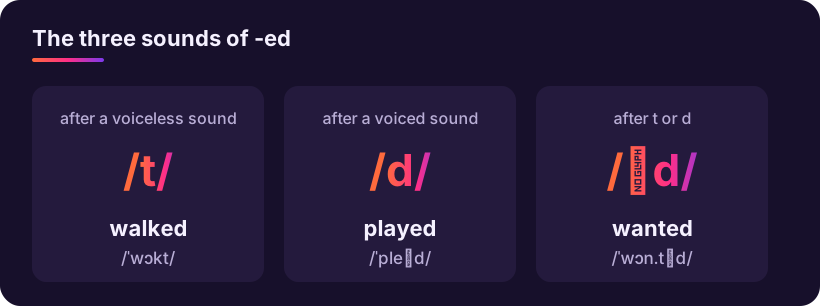
The -ed ending has three sounds
The past-tense -ed works the same way:
- after a voiceless sound it is t: walked /ˈwɔkt/
- after a voiced sound it is d: played /ˈpleɪd/
- after t or d it adds a syllable, ɪd: wanted /ˈwɔn.tɪd/
Where the stress goes
Stress is the syllable you say longer, louder and higher. Getting it wrong makes a word harder to recognize than a slightly off vowel does.
English has no single rule for where stress falls. Some languages fix it in one place, such as the first syllable in Finnish and Czech, or the second-to-last in Polish. In English the stress belongs to each word and can even tell two words apart, as with the noun and verb increase. It is largely unpredictable, so it has to be learned word by word. The tendencies below narrow the guess, and a dictionary settles it.
Two-syllable nouns and verbs
Two-syllable nouns usually stress the first syllable, and two-syllable verbs often stress the second. That's why the noun record, ˈrɛkɚd, and the verb record, rɪˈkɔrd, sound different. This is a tendency, not a rule. hello /hɛˈloʊ/, for example, stresses the second syllable.
Endings that move the stress
Some endings pull the stress to the syllable right before them. Words ending in -ic do this, as in phonetic [fəˈnɛɾ.ɪk]. So do -tion and -ity. Words ending in -ate often stress two syllables back.
Long words
In long words, find the main stress first and let the other syllables relax toward schwa. onomatopoeia /ˌɑnəˌmætəˈpiːə/ has six syllables but only one strong beat, near the end.
When the main stress falls on the third syllable, a lighter beat usually lands on the first, not the second. intervene /ˌɪn.tɚˈvin/ works like this: the strong beat is on -vene, the part that carries the stress in convene /kənˈvin/ too, and in- gets the lighter beat, while the middle syllable stays weak.
American features to listen for
The flapped t
Between vowels, an American t often becomes a quick tap that sounds close to a soft d. That's why water /ˈwɔ.tɚ/ sounds like "wadder" in most of the US.
The dark l
At the end of a syllable, l is said with the back of the tongue raised, giving it a darker, deeper sound, as in full /ˈfʊl/ and milk /ˈmɪlk/.
Connected speech
In normal speech, words run together. A final consonant links to a next word that starts with a vowel, so "an apple" sounds like "a napple". Small words like and, to and of shrink to weak forms with schwa. Practice single words first, then whole phrases at normal speed.
English pronunciation rules from A to Z
A one-line pattern for each letter. Exceptions exist for almost every line. When in doubt, check the word in the A–Z word list or type it into the pronunciation tool.
| Letter | The pattern to know | Example |
|---|---|---|
| A | short æ before a consonant; long eɪ with a silent e | plague /pleɪɡ/ |
| B | silent after m and before t | climb /ˈklaɪm/ |
| C | s before e, i, y; k elsewhere | cycle /ˈsaɪ.kəl/ |
| D | d in -ed after voiced sounds; ɪd after t or d | needed /ˈni.dəd/ |
| E | silent at the end of a word, lengthening the vowel before it | hope /ˈhoʊp/ |
| F | always f, except in of | of /ˈʌv/ |
| G | often dʒ before e, i, y; silent in gn | sign /ˈsaɪn/ |
| H | silent in a few words | honest /ˈɑ.nəst/ |
| I | short ɪ before a consonant; long aɪ with a silent e | quite /kwaɪ̯t/ |
| J | dʒ in English words; borrowed words vary | judge /d͡ʒʌd͡ʒ/ |
| K | silent before n | knife /ˈnaɪf/ |
| L | dark at the end of a syllable; silent in -alm and -alk | calm /ˈkɑm/ |
| M | always m | mom /ˈmɑm/ |
| N | ŋ before k or g | think /ˈθɪŋk/ |
| O | ɑ in many short American words; oʊ with a silent e | hot /ˈhɑt/ |
| P | silent in ps- and pn- | psychology /saɪˈkɑ.lə.dʒi/ |
| Q | almost always written qu, said kw | question /ˈkwɛs.tʃən/ |
| R | pronounced after vowels in General American | world /wɝld/ |
| S | often z between vowels and at the end of plurals | rose /ˈɹoʊz/ |
| T | often a quick tap between vowels in American English | butter /ˈbʌ.tɚ/ |
| U | short ʌ, or long u and ju | cute /ˈkjut/ |
| V | always v | vital /ˈvaɪtəl/ |
| W | silent before r | wrong /ˈɹɔŋ/ |
| X | ks at the end, ɡz before a stressed vowel, z at the start | xylophone /ˈzaɪləˌfoʊn/ |
| Y | j at the start of a word; aɪ, ɪ or i as a vowel | yacht /jɑt/ |
| Z | always z; the letter itself is "zee" in the US | zip /ˈzɪp/ |
When the rules fail, listen
Every pattern above has exceptions, and some of the most common words are the strangest: women /ˈwɪmɪn/, eight /eɪt/, through /θɹu/. Don't try to memorize every exception. Look the word up, play it, and say it back until it feels natural.
Frequently asked questions
How many rules of English pronunciation should I master?
There is no official number. This guide gives sixteen patterns, from short vowels to the flapped t, and between them they cover most everyday words. Learn those well, keep the A–Z table for reference, and look up the exceptions as you meet them instead of memorizing long lists.
Why is there no rule for which syllable is stressed?
Because in English the stress is part of each word, not set by the language as a whole. Some languages always stress the same syllable, but English stress is largely unpredictable and has to be learned word by word. The tendencies in this guide, such as nouns stressing the first syllable and -ic pulling the stress next to it, get you most of the way.
How should one pronounce education — is edjucation wrong?
It isn't wrong. The d in education runs into the "you" sound after it and becomes a j sound, and that is how Americans say the word. British speakers use the same j form or a more careful "ed-you-cation". Both are correct.
Why are put and but pronounced differently?
They used to share a vowel. A few hundred years ago, short u changed to the "uh" sound in most words, including but, while it often stayed unchanged in words like put, pull and push. In much of northern England the change never happened, and the two words still rhyme there.
Why does queue have 4 silent letters?
Because English kept the French spelling. Queue comes from the French word for tail, and English says it with a single sound, the name of the letter q. The four letters after the q spell that "you" sound together, so none of them is said separately.
How do you pronounce the bi- prefix?
Usually like the word "bye", with the long i of its letter name, as in bicycle and bilingual. The prefix means two or twice. A short i version exists, but it's rare.
Pronunciations come from our checked word data. The sources are listed on our Credits page.