
Guide 08 of 15
English pronunciation exercises for Spanish speakers, plus Korean and Vietnamese
If the same English words keep coming out wrong however long you practice, the cause is your first language, and the fix is to find the specific gaps between it and English and drill exactly those. You've put in the work. Your first language has its own set of sounds and its own rules for how syllables are built, and your mouth falls back on them whenever an English sound is missing from that set.
This guide lists the usual gaps for Spanish, Korean and Vietnamese speakers, with exercises for each. The gaps come from published comparisons of each language's sound system; the sources are listed on our Credits page.
Why your first language shapes your English
Every language uses a limited set of sounds and allows only certain sound combinations. If your language has no θ, your mouth reaches for the nearest sound it knows, often t or s. If your language never ends a word in two consonants, you may drop one, or add a vowel to split them. These slips are predictable, so you can aim your practice straight at them.
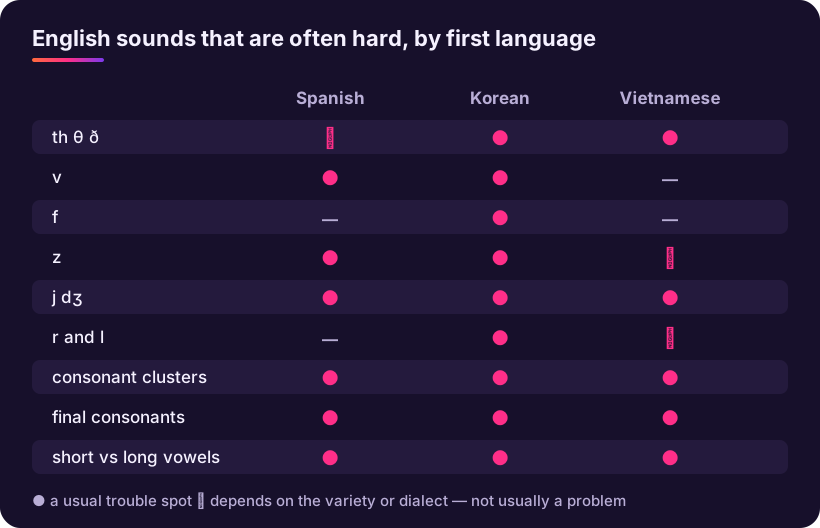
Consonants and word endings are fixed the same way, whatever your first language. Find where the sound is made: the lips, the top teeth on the lower lip, the tongue tip just behind the top teeth, or the tongue pulled back. Say the sound alone, then at the end of a short word, then in a phrase. Give endings the most care, because in English they carry meaning: a final s can mark a plural, and a final d or t the past, so a dropped ending changes what you said, not just how it sounds.
S and sh are a pair many learners blur, as in sock /ˈsɑk/ and shock /ˈʃɑk/. The difference is where your tongue sits. For s, the tip or blade of the tongue comes close to the gum ridge just behind the top teeth. For sh, the tongue sits a little further back, behind that ridge, and English speakers often round their lips slightly as well. Spanish and Korean have no sh sound, so speakers of both often need this pair. Alternate save /ˈseɪv/ and shave /ˈʃeɪv/, then sort /ˈsɔɹt/ and short /ˈʃɔɹt/, slowly at first, until each one comes out on purpose.
Spanish speakers
The trouble spots
- Vowels. Spanish has five vowel sounds. English has many more, so pairs like ship /ˈʃɪp/ and sheep /ˈʃip/ can sound identical to a Spanish ear.
- B and v. Spanish doesn't separate b and v the way English does: berry /ˈbɛ.ɹi/ and very /ˈvɛ.ɹi/ can merge. Between vowels, Spanish b, d and g also soften, which can blur English words.
- Th. Most Spanish varieties have no θ or ð. Castilian Spanish does have θ, which helps speakers from Spain.
- Z, sh and the English j. English z, ʃ and dʒ are not part of Spanish, so zoo /ˈzu/ can turn into sue, shoe /ˈʃu/ into chew, and jet /ˈdʒɛt/ into yet.
- S at the start of a cluster. Spanish words don't begin with s plus a consonant, so an e sneaks in: "espeak" for speak /ˈspik/.
- Word endings. Spanish words end in only a few consonants, so English endings get dropped: the ed in walked /ˈwɔkt/, or the final s in cats /ˈkæts/.
Exercises
- Minimal pairs: ship / sheep, berry / very, zoo / sue, shoe / chew, jet / yet. Say each pair five times, then have someone say one at random while you point to it.
- No extra e: say smile /ˈsmaɪl/, study /ˈstʌ.di/ and school /skul/ with your lips already shaped for s, and start the s directly, with no vowel before it.
- Finish the ending: read played /ˈpleɪd/, wanted /ˈwɔn.tɪd/ and dogs /ˈdɑɡz/ and exaggerate the last sound.
Korean speakers
The trouble spots
- F and v. Korean has no f or v, so fan /ˈfæn/ can sound like pan /ˈpæn/, and vase /veɪ̯s/ can start with a b.
- R and l. Korean uses one sound that changes with its position, so English right /ˈɹaɪt/ and light /ˈlaɪt/ are easy to confuse.
- Th, z and sh. These sounds are absent from Korean: three /θɹiː/ can become tree, zebra /ˈziː.bɹə/ can start with a j sound, and sh needs practice of its own.
- Consonant clusters and final consonants. Korean syllables don't stack consonants, and only a few consonants can end a syllable. A vowel often appears between consonants, so street /ˈstɹit/ gains extra syllables.
- Vowel pairs. bed /ˈbɛd/ and bad /ˈbæd/, and the short and long ee sounds, can merge.
- Stress and melody. English word stress and sentence intonation differ from Korean rhythm, so whole phrases can sound flat.
Exercises
- Lip and teeth: for f and v, rest your top teeth on your lower lip and blow (f) or buzz (v). Alternate fan / pan and vase / base.
- R vs l: for r, pull the tongue back without touching anything. For l, press the tip behind your top teeth. Alternate right / light and road /ˈɹoʊd/ / load /ˈloʊd/.
- No hidden vowels: say spring /ˈspɹɪŋ/ and strong /ˈstɹɔŋ/ as single syllables, tapping once per word.
Vietnamese speakers
The trouble spots
- Final consonants. Vietnamese words can end in only a few consonants. English final s and z sounds are often dropped, losing plurals and verb endings: books /ˈbʊks/, buses /ˈbʌ.sɪz/.
- Consonant clusters. Vietnamese has no clusters, so splash /ˈsplæʃ/ or text can lose a sound.
- Th, ch and the English j. θ, ð, tʃ and dʒ are absent: that /ˈðæt/ and chair /ˈtʃɛɹ/ need practice.
- Sounds that depend on your dialect. Whether z, sh and r come easily depends on your region of Vietnam.
- Word stress. Vietnamese is tonal and mostly one-syllable, so the English pattern of one strong syllable in a long word is new. important /ɪmˈpɔɹ.tənt/ needs its beat on POR.
- Short vowels. The short ɪ and ʊ, as in pull /ˈpʊl/, often need extra work.
Exercises
- Hold the ending: say hats /ˈhæts/, boxes /ˈbɑk.səz/ and kids /ˈkɪdz/, and hold the final sound for a full second.
- Stress tapping: tap the table on the stressed syllable of pronunciation /pɹəˌnʌn.siˈeɪ.ʃən/, detergent /dɪˈtɝd͡ʒənt/ and entrepreneur /ˌɑn.tɹə.pɹəˈnɝ/, then play each word to check where the beat falls.
- Clusters, slowly: build strength /ˈstɹɛŋkθ/ one sound at a time, s, st, str, until the whole word comes out in one syllable.
How to check yourself
Pick the three trouble spots from your language's list that you notice most in your own speech. Practice only those for two weeks. Then:
- Play, then say. Type each practice word into the pronunciation tool, play it at half speed, then say it back.
- Use the voice check. Every word page has one. If the word you said isn't recognized as the word you meant, the sound you're working on still needs practice.
- Record a minute of speech at the start and after two weeks, and compare.
Your accent is part of who you are, and nobody needs to lose it. The goal is that the sounds which change meaning, like ship and sheep, come out the way you mean them.
Frequently asked questions
How do you fix consonant sounds and word endings?
Work on one sound at a time. Find where it is made, say it alone, then at the end of a short word, then in a phrase, and slow down enough to finish every word. Give endings the most care: a final s or d often carries a plural or a past tense, so dropping it changes your meaning. The list for your first language shows which consonants and endings to start with.
How do I fix my pronunciation problem with S and SH?
Move your tongue. For s, it comes close to the gum ridge just behind your top teeth; for sh, it sits a little further back, and English speakers often round their lips slightly. Practice pairs that differ only in that sound, such as sock and shock or save and shave, slowly at first. The pair is hardest for speakers whose first language has no sh at all, such as Spanish and Korean.
Is difficulty with L and R common when learning English?
Yes, and it's predictable. Some languages, such as Korean, use one sound that changes with its position where English uses two, so right and light can sound alike. The fix is a clear tongue position for each: for r, pull the tongue back without touching anything; for l, press its tip behind your top teeth.
Why do I pronounce th as v, f or d?
Because your first language most likely has no th, and the two th sounds are not very common among the world's languages. Your mouth reaches for the nearest sound it already knows. Some learners use t and d, others s and z, and f and v are a common swap too, even among some native English speakers. To make the real sound, rest the tip of your tongue lightly against your top teeth and push air past it.