Guide 02 of 15
Pronunciation symbols: how to read the IPA in your dictionary
When a dictionary prints a row of strange symbols next to a word, like an upside-down e, a curly ʃ or a tick mark, you're looking at a code for how the word sounds, and you can learn to read it in an afternoon.
Below is the full set of US English sounds, each with a word you can play. After the chart come the marks around the symbols (stress, slashes, syllable dots), the schwa, and one real word read symbol by symbol.
The US English sound chart
The International Phonetic Alphabet, IPA, gives one symbol to each sound, so a symbol always means the same sound, whatever the spelling. Play each example and listen for the sound its symbol stands for.
Consonants that look like ordinary letters
Most consonant symbols are just the letters you know, said the usual way: p b t d k f v s z h m n l w. The ones below need a second look.
| Symbol | Sound | Example |
|---|---|---|
| θ | th without voice | three /θɹiː/ |
| ð | th with voice | that /ˈðæt/ |
| ʃ | sh | shoe /ˈʃu/ |
| ʒ | the middle of measure | measure /ˈmɛ.ʒɚ/ |
| tʃ | ch | cheap /ˈtʃip/ |
| dʒ | j | judge /d͡ʒʌd͡ʒ/ |
| ŋ | ng | sing /ˈsɪŋ/ |
| j | y, never the English j | yacht /jɑt/ |
| ɹ or r | the English r | roof /ɹuːf/ |
| ɡ | always the hard g | GIF /ɡɪf/ |
| ɾ | the quick American tap | phonetic [fəˈnɛɾ.ɪk] |
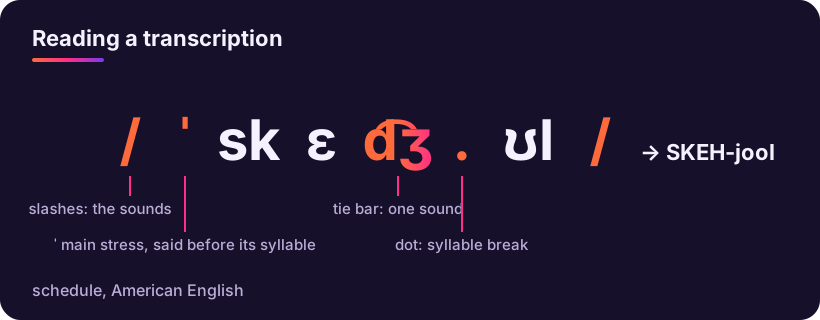
A small arc above or below two symbols, as in t͡ʃ or d͡ʒ, ties them into one sound.
Vowels
| Symbol | Example | Symbol | Example |
|---|---|---|---|
| i | please /pliz/ | ɪ | six /sɪks/ |
| eɪ | eight /eɪt/ | ɛ | debt /ˈdɛt/ |
| æ | bag /bæɡ/ | ɑ | psalm /sɑm/ |
| ɔ | water /ˈwɔ.tɚ/ | oʊ | quote /kwoʊt/ |
| ʊ | book /ˈbʊk/ | u | route /ɹut/ |
| ʌ | humble /ˈhʌmbəl/ | ə | salmon /ˈsæmən/ |
| ɝ | world /wɝld/ | ɚ | zephyr /ˈzɛfɚ/ |
| aɪ | site /saɪt/ | aʊ | how /haʊ/ |
| ɔɪ | boy /ˈbɔɪ/ |
Many Americans say ɔ and ɑ the same way, so water and psalm may share a vowel in your accent. Some dictionaries also add a length mark, ː, to long vowels, writing iː or uː where others write i or u. Both mean the same sound.
Diphthongs
eɪ, aɪ, aʊ, oʊ and ɔɪ are diphthongs: one vowel gliding into another inside a single syllable. Say eight slowly, and you'll feel your tongue move from e toward ɪ.
The marks around the symbols
Stress marks
A raised tick, ˈ, goes before the syllable with the main stress. A lowered tick, ˌ, marks a lighter secondary stress. entrepreneur /ˌɑn.tɹə.pɹəˈnɝ/ has both: a light beat at the start and the main beat on the last syllable.
Slashes and square brackets
Slashes, / /, show the sounds a listener needs to tell the word apart. Square brackets, [ ], show finer detail, like the tap in phonetic. Our word page for phonetic shows it in brackets for exactly that reason: the transcription records the tap.
Syllable dots
A dot inside a transcription, as in ˈwɔ.tɚ, marks where one syllable ends and the next begins.
The upside-down e: schwa
The upside-down e, ə, is called schwa. It is a short, relaxed "uh", and it is the most common vowel sound in English, because almost every unstressed vowel drifts toward it. Any vowel letter can be spelled for it: the o at the start of pronunciation /pɹəˌnʌn.siˈeɪ.ʃən/, and the o in salmon. When you see ə, don't stress it. Keep it short and light.
IPA or respelling?
Dictionaries use two kinds of pronunciation key:
- IPA, the system on this page, used worldwide and by language teachers.
- Respelling, which writes sounds with ordinary letters and marks, such as kwee-NOH style spellings or a vowel with a line over it for a long sound. Each dictionary's respelling key is a little different, so always check the key in the book you're using.
IPA takes a little longer to learn but means the same thing everywhere. Respelling is quicker to read but changes from one publisher to the next.
American and British transcriptions
The same word can have a different transcription in each accent, and the symbols tell you exactly where they differ. vase /veɪ̯s/ is veɪs in the US, rhyming with face, but vɑːz in Britain. British transcriptions also drop the r sound after vowels, which American ones keep.
Reading one word, symbol by symbol
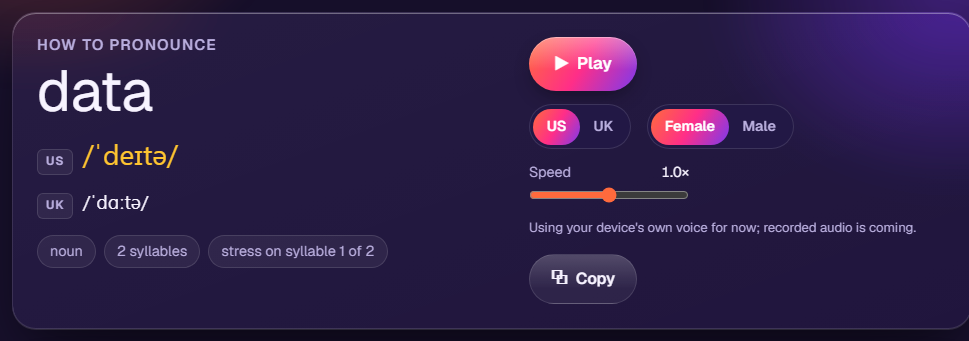
Take schedule /ˈskɛd͡ʒ.ʊl/, written /ˈskɛd͡ʒ.ʊl/ in American English:
- ˈ: the stress falls on the first syllable.
- sk: an s and a k. American English says sk here, where many British speakers say sh.
- ɛ: the short e of debt.
- d͡ʒ: the j sound, tied into one sound.
- .: the syllable break.
- ʊl: a short oo followed by an l.
Put it together and you get "SKEH-jool". Play it to check.
Sounds from other languages
Some dictionaries add symbols for sounds English borrowed with foreign words, such as the nasal vowels of some French borrowings or the throat sound x of Scottish English and German. You'll rarely need them. When you do, play the word rather than guessing. You can try any word in the pronunciation tool.
Frequently asked questions
What is the upside-down e in a pronunciation guide?
It's schwa, a short and relaxed "uh". It is the most common vowel sound in English, because almost every unstressed vowel drifts toward it, whichever letter spells it. When you see it, keep the sound short and light, and never put the stress on it.
What do the symbols in a pronunciation key mean?
Each symbol stands for one sound, and it means that same sound whatever the spelling. Most consonant symbols are ordinary letters said the usual way. The ones that need learning, such as the symbols for th, sh and ng, and the vowel symbols, are in the chart above, each with a word you can play.
What is pronunciation respelling?
Respelling is the other kind of pronunciation key. Instead of phonetic symbols, it writes a word's sounds with ordinary letters and a few marks, such as a line over a long vowel. It's quicker to read at first, but each dictionary uses its own respelling key, so check the key in the one you're using. IPA means the same thing everywhere.
How do you pronounce a word using IPA?
Read it one symbol at a time, from left to right. Find the raised tick first, because the syllable right after it carries the main stress. Then say each symbol's sound, note where a dot marks a syllable break, and join the syllables together. Play the word afterwards to check what you worked out.
Pronunciations come from our checked word data. The sources are listed on our Credits page.