
Guide 09 of 15
The English pronunciation poem, "The Chaos", and how to read it aloud
If someone has dared you to read an English pronunciation poem aloud and you're stuck by the third line, you can still read it well: learn the handful of spelling traps it repeats, practice them as pairs, and then read it slowly, one stanza at a time. The poem is almost certainly "The Chaos", the best-known poem of its kind, and it works by rhyming words that look alike but sound different, and words that look different but rhyme.
This guide covers the poem's story first, then the traps, with audio, and a way to practice.
What the poem is
"The Chaos" is a long rhyming poem that walks through the oddities of English spelling. It opens:
Dearest creature in creation, / Study English pronunciation.
From there it piles up pairs that defeat anyone reading by the rules: words that look as if they should rhyme but don't, and words that rhyme despite completely different spellings. It gets harder as it goes, and by the end almost every line holds a trap.
Who wrote it, and when
The poem was written by Gerard Nolst Trenité, a Dutch writer and teacher of English who lived from 1870 to 1946. It first appeared in 1920, in an appendix to his English pronunciation textbook for Dutch learners. He kept expanding it, and the last edition published in his lifetime, in 1944, is nearly twice as long as the first.
Because it was copied around for decades, often without the author's name, many slightly different versions now exist. Some are from the 1920 text, some from the longer 1944 text, and some are edited later versions with a few hundred lines.
The traps the poem is built on
The poem relies on a few kinds of spelling trap. Learn to spot them, and every line becomes easier.
Same spelling, different sounds
The letters ough alone have several different sounds:
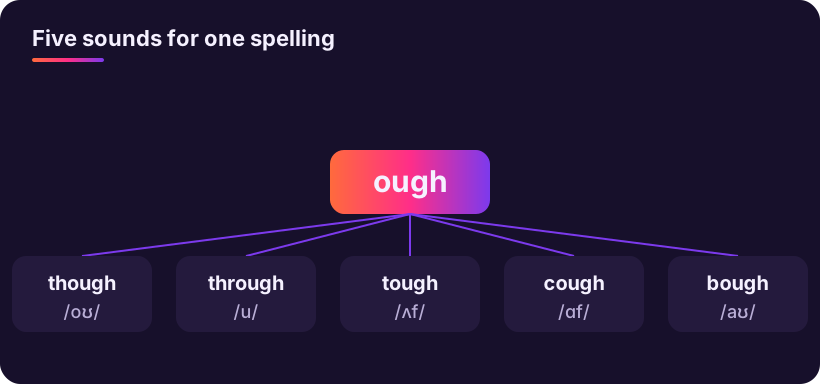
| Word | The ough sounds like |
|---|---|
| though /ˈðoʊ/ | oh |
| through /θɹu/ | oo |
| tough /ˈtʌf/ | uff |
| cough /ˈkɑf/ | off |
| bough /ˈbaʊ/ | ow |
The same trick works with ear: heard /ˈhɝd/ and beard /ˈbɪɹd/ look like a rhyme but aren't one.
Different spelling, same sound
Some words rhyme even though they're spelled differently: said /ˈsɛd/ rhymes with red, not with paid /ˈpeɪd/. The poem uses dozens of these.
One letter makes all the difference
corpse /ˈkɔɹps/ and corps /ˈkɔɹ/ differ by one letter, but the ps is silent in corps. horse /hoɹs/ and worse /ˈwɝs/ look like partners, yet their vowels differ. low /ˈloʊ/ and now /ˈnaʊ/ share ow, with two different sounds.
Words that break every pattern
A few everyday words follow no pattern at all, and poems like this one love them. colonel /ˈkɝnəl/ is said like kernel, with no l sound in the middle. women /ˈwɪmɪn/ sounds as if it were spelled wimmin. Learn these as whole words; no rule will help.
The kernel sound of colonel is a leftover from its history. The word reached English in the 1500s from French, where it was spelled coronnel, with an r, though it goes back to the Italian colonnello. In the 1580s, learned writers changed the English spelling to match the Italian, but the r and l pronunciations went on side by side until around 1650. After that only the r form survived, so the spelling and the sound now come from two different versions of the word. British English says it the same way.
Old and British pronunciations
The poem was written by a teacher of British English a century ago. A few of its rhymes only work in British English, or in the English of its time. If a line doesn't rhyme in your accent, that's the reason, and it isn't your mistake.
How to read it aloud
- Read a stanza silently first, and mark every word you're unsure of.
- Look up each marked word and play it. Learn the trap word on its own before you meet it in the line.
- Read slowly, keeping a steady beat. The rhythm helps: if a word breaks the meter, you probably have the wrong stress.
- Read the stanza at normal speed, then move on. Don't try the whole poem in one sitting.
- Record yourself after a week, and compare.
Using it as practice
The poem makes a good long-term practice text because it collects the traps in one place. Take one stanza a day. Write each hard word in a list, and come back to the list at the end of the week. You can type any of them into the pronunciation tool to check its sound.
Treat it as a game, not a test. Native speakers stumble over it too, and that's half its fame.
A different poem with the same idea
A second, shorter poem is often confused with "The Chaos". It plays with tough, bough, cough and dough and offers advice "for foreigners". It is a separate poem by a different writer. If the version you were sent is only a few verses long and built around ough words, it's probably that one. It teaches the same lesson.
Frequently asked questions
Which poem starts "Dearest creature in creation"?
That is "The Chaos", the English pronunciation poem. Its first two lines are "Dearest creature in creation, / Study English pronunciation." From there, it strings together words that look as if they should rhyme and don't, and words that rhyme even though they are spelled differently.
Who wrote the English pronunciation poem "The Chaos"?
Gerard Nolst Trenité, a Dutch writer and teacher of English who lived from 1870 to 1946. It first appeared in 1920, at the back of his English pronunciation textbook for Dutch learners, and he kept expanding it up to the 1944 edition.
Why do Americans pronounce colonel as ker-nel?
Not only Americans: British speakers say it that way too. English first took the word from French in the 1500s in a form spelled with an r. The spelling was later changed to match the Italian, with an l, but by about 1650 only the old r pronunciation was left in use. The spelling changed and the sound didn't.
How do you pronounce "ough" in the last five words?
Take the five ough words in the table above: the letters sound like "oh" in though, "oo" in through, "uff" in tough, "off" in cough and "ow" in bough. The spelling gives no clue which one you need, so learn each word whole.
Pronunciations come from our checked word data. The sources are listed on our Credits page.