
Guide 05 of 15
How to improve your English pronunciation, step by step
If people still ask you to repeat yourself after years of English, the cure is practice for your ear and your mouth, not more reading: train your ear with slowed audio, copy one model, fix stress before single sounds, record yourself, and practice ten minutes a day. Your vocabulary is fine. Pronunciation is a physical skill, like a tennis serve, and reading about it won't train it.
The eight steps below take those habits one at a time, and a ten-minute routine closes the guide.
1. Train your ear before your mouth
You can't say a difference you can't hear. Start every practice session by listening, not speaking.
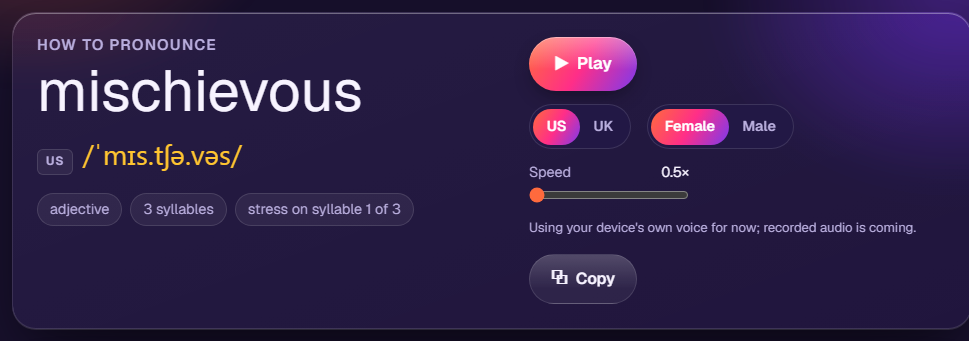
Slow audio helps. On any word page here, set the speed to half, play the word, then switch back to normal speed. Listen for the stressed syllable first, then the vowels. Try it with mischievous /ˈmɪs.tʃə.vəs/, which many people stress wrongly. The strong beat is on the first syllable, and it has three syllables, not four.
2. Choose one model and copy it
Pick one accent to imitate, and one or two speakers whose voice you like: a newsreader, a podcast host, an actor. Listen to them every day, through TV, podcasts or audiobooks. Copying one consistent model is faster than averaging many different voices.
3. Shadow: speak along with the audio
Shadowing means repeating what you hear a split second behind the speaker, matching their rhythm and melody. Start with short clips, a sentence or two. Read the text first if you need to, then shadow without it. Reading aloud from a book does the same job when you have no audio.
4. Fix stress and rhythm before single sounds
Listeners recognize words by their stress pattern first. Say hyperbole /haɪˈpɝbəli/ with the stress on the first syllable, and listeners will struggle even if every vowel is perfect. The beat belongs on the second syllable.
English rhythm comes from stressed syllables being long and clear while unstressed ones shrink. Clap the beats of a sentence, then say it so the stressed words land on the claps.
Clear and natural are two separate things, and neither one means losing your accent. Clear means a listener catches every word the first time: the beat sits on the right syllable, the sounds that keep words apart stay apart, and each word is finished, endings and all. Natural is mostly this rhythm of long and short syllables. Studies of learners' speech have found that how strong an accent sounds and how easily it is understood are partly separate, so you can be easy to follow and still sound like yourself.
5. Watch your mouth
Use a mirror for the sounds your first language doesn't have:
- th in three /θɹiː/: the tip of the tongue shows between the teeth.
- v in virtue /ˈvɝt͡ʃu/: the top teeth touch the lower lip, and the voice buzzes.
- w in wet /ˈwɛt/: the lips round, and the teeth don't touch.
- r in roof /ɹuːf/: the tongue pulls back and never touches the roof of the mouth.
Vowels need the mirror too. Each English vowel is shaped by three things you can see or feel: how far your jaw drops, where your tongue sits (high or low, forward or back), and whether your lips round. For the vowel in seat /ˈsit/, the tongue is high and forward, and the lips stay unrounded. For food /ˈfud/, the tongue stays high but moves back, and the lips round and push forward. For hot /ˈhɑt/, the jaw opens and the tongue lies low. If two vowels sound the same to you, watch which of the three changes between them.
6. Use minimal pairs
Minimal pairs are two words that differ in just one sound: ship /ˈʃɪp/ and sheep /ˈʃip/, fan /ˈfæn/ and van /ˈvæn/, light /ˈlaɪt/ and right /ˈɹaɪt/. Practice them in pairs, then ask a friend to say one at random and point to which they said. If your first language merges a pair, the guide for speakers of other languages lists the pairs worth practicing.
Not every slip matters equally. The ones that cause real misunderstandings turn one word into another: two sounds merged, so light comes out as right; the stress in the wrong place; an ending dropped, so worked becomes work. When both speakers learned English as a second language, one small study of their misunderstandings found most came from consonants heard as other consonants, from consonants lost at the start of a word, and from long and short vowels said at the same length, as in heat /ˈhit/ and hit /ˈhɪt/. A th said as another sound rarely caused trouble there.
7. Record yourself and compare
You don't hear your own voice the way others do. Record a sentence, play a model of the same sentence, and compare them side by side. Listen for one thing at a time: stress first, then vowels, then word endings.
Every word page here has a voice check. Say the word aloud and see whether it was recognized as the word you meant. It's a quick, honest test of whether a stranger would understand you.
8. Slow down, and practice little and often
Fast speech hides mistakes but also hides your words. Speak a little slower than feels natural, and finish every word, including its final consonants: the ld at the end of world /wɝld/, and the kt at the end of worked /ˈwɝkt/. Ten minutes every day does more than an hour on Sunday, because the muscles of speech learn through repetition.
Use the music of a sentence
Your voice goes up and down as you speak, and that tune is part of the meaning. English uses two main tunes at the end of a sentence:
- Falling: the voice drops at the end. Use it for statements, such as I live in Ohio., and for questions that start with a question word such as what, where or how: Where do you live?
- Rising: the voice goes up at the end. Use it for yes/no questions, such as Do you live here? A one-word question like really /ˈɹɪ.li/ rises too, when you are surprised.
The tune moves most on one word: the word that brings new information. If someone asks Which car is yours?, you answer The red one, and your voice jumps on red, because car is already known. Move that weight, and the meaning moves with it. I didn't take the book stressed on I says someone else took it. Stressed on book, it says you took something else.
A flat voice can sound bored or unfriendly even when every word is clear. To practice, hum a sentence with your lips closed, then say it with the same tune. Shadowing, from step 3, is the easiest way to pick up your model speaker's tunes.
A ten-minute daily routine
| Minutes | What to do |
|---|---|
| 0–2 | Listen to a short clip from your model speaker, twice. |
| 2–5 | Shadow the same clip three times. |
| 5–7 | Five minimal pairs, each said five times. |
| 7–9 | Three new words: look each up, play it slowly, say it back. |
| 9–10 | Record one sentence, and compare it with the model. |
How to track progress
Keep a short list of words you find hard, and test yourself on it each week. Record the same paragraph once a month, and keep the files. Progress in pronunciation is slow, day to day, but obvious when you compare this month's recording with one from three months ago.
If a word gives you trouble, look it up in the pronunciation tool and learn how to read its symbols with the pronunciation symbols guide.
Frequently asked questions
What makes pronunciation clear and natural?
Clear pronunciation is speech a listener understands the first time. Three things carry most of it: the stress on the right syllable, the sounds that tell words apart kept apart, and every word finished, endings included. Natural pronunciation comes mostly from rhythm, with stressed syllables long and clear and the rest short. Neither needs a native accent, because how strong an accent sounds and how easily it is understood are partly separate.
How can you improve English vowel sounds?
Start with your ear: play a word at half speed and listen for its vowel before you try it. Then practice vowels in minimal pairs, two words that differ only in that vowel, with a mirror in front of you. Every vowel depends on how far the jaw opens, where the tongue sits and whether the lips round, so when two vowels sound alike to you, find which of those three changes between them.
What mispronunciations lead to misunderstandings between foreigners?
The slips that matter turn one word into another: two sounds merged, the stress on the wrong syllable, an ending dropped. In one small study of conversations between speakers who had both learned English, most misunderstandings came from consonants taken for other consonants, consonants lost at the start of a word, and long and short vowels said at the same length. A th said as another sound rarely got in the way.
What are the advantages of knowing correct pronunciation?
The biggest one is being understood the first time, so people stop asking you to repeat yourself. Listeners also have to work less to follow you, and researchers treat that ease as something separate from how strong your accent sounds. So you get both benefits without giving up the way you sound.
How can you check if your pronunciation is correct?
Record yourself saying a sentence, play a model of the same sentence, and compare one thing at a time: stress first, then vowels, then endings. For a single word, use the voice check on its word page: say the word and see whether it was recognized as the word you meant.
Does your voice go up or down at the end of a question?
It depends on the question. Yes/no questions, like Do you live here?, usually rise at the end. Questions that start with a question word, like Where do you live?, usually fall, the same as a statement.
Pronunciations come from our checked word data. The sources are listed on our Credits page.