Guide 06 of 15
English pronunciation for beginners: where to start
If you're starting English pronunciation and don't know what to learn first, you need just five things, in this order: long and short vowels, word stress, th, final consonants and schwa, and the first two make the biggest difference to how well people understand you. Most beginners try everything at once (the alphabet, the symbols, the hundred spelling rules) and remember nothing.
Lesson 1 is below, with audio for every word. After it come ten everyday words to practice, a short quiz, and where to go next.
The first five things to learn, in order
- Long and short vowels. English separates sheep /ˈʃip/ from ship /ˈʃɪp/. Many languages don't.
- Word stress. Every word with two or more syllables has one strong beat. Put it in the wrong place, and the word becomes hard to recognize.
- The th sounds. θ as in three /θɹiː/ and ð as in that /ˈðæt/. Both are rare in other languages and very common in English.
- Final consonants. English words often end in consonants, sometimes two or three: text /tɛkst/. Say every one.
- Schwa. The weak "uh" sound in unstressed syllables. It makes English rhythm sound natural.
Lesson 1: vowel length and word stress
Long and short vowels
Say these pairs. The first word in each has a short, relaxed vowel, and the second a longer, tenser one:
| Short | Long |
|---|---|
| sit /ˈsɪt/ | seat /ˈsit/ |
| full /ˈfʊl/ | fool /ˈful/ |
| bit /ˈbɪt/ | beat /ˈbit/ |
For the short ɪ, relax your mouth. For the long i, smile slightly and hold the sound a little longer.
Word stress
The stressed syllable is longer, louder and a little higher than the others. Listen to these three words, and clap on the strong beat:
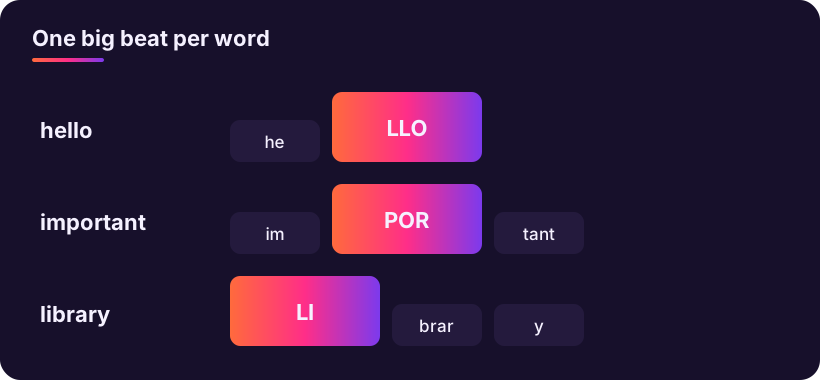
Each block in the picture is a syllable. The big block is where your voice goes up and the syllable gets longer. Say the words while tapping the table, once lightly and once hard.
Ten everyday words to practice
These words come up in almost every conversation. Play each one, then say it back three times.
| Word | Watch for |
|---|---|
| please /pliz/ | a long i, and it ends in a z sound |
| water /ˈwɔ.tɚ/ | the American t sounds like a quick d |
| what /ˈwʌt/ | a short ʌ, like "wut" |
| how /haʊ/ | one smooth glide, aʊ |
| your /joɹ/ | one syllable in American English |
| world /wɝld/ | r and l together, then a final d |
| question /ˈkwɛs.tʃən/ | kw at the start, ch in the middle |
| eight /eɪt/ | the gh is silent |
| women /ˈwɪmɪn/ | the o is said as a short ɪ |
| six /sɪks/ | a short ɪ, then ks |
The spelling patterns beginners need first
You don't need every rule at the start. These six cover a lot of everyday words:
- A silent e at the end makes the vowel before it say its name: site /saɪt/.
- Short words with one vowel before a consonant usually have a short vowel: bag /bæɡ/.
- C before e, i or y sounds like s: city /ˈsɪ.ti/.
- Kn and wr at the start drop the first letter: know /ˈnoʊ/, write /ˈɹaɪt/.
- The -s ending can sound like s, z or iz: tips /tɪps/, labs /ˈlæbz/, exercises /ˈɛk.sɚ.saɪ.zɪz/.
- The -ed ending can sound like t, d or id: walked /ˈwɔkt/, played /ˈpleɪd/, wanted /ˈwɔn.tɪd/.
When you're ready for more, the spelling patterns guide has the full set, from A to Z.
Mistakes beginners make most
- Adding a vowel before or after consonant groups: "estreet" for street /ˈstɹit/, or "texta" for text.
- Saying every letter, including silent ones, like the b in debt /ˈdɛt/.
- Making every syllable equal. English rhythm needs strong and weak beats.
- Swapping sh and s, or th and t, under pressure. Slow down rather than guess.
Quick quiz: where's the stress?
Say each word aloud, decide which syllable is strong, then play it to check. The answers are below the list.
Answers: 1. ZE-bra, the first syllable. 2. de-TER-gent, the second. 3. u-MA-mi, the second. 4. u-ku-LE-le, the third. 5. CAR-mel, the first. Many Americans say it in two syllables.
What to do next
Once these feel comfortable, learn to read the symbols dictionaries use with the pronunciation symbols guide. Then look up every new word you meet in the pronunciation tool before you say it for the first time. The habit of checking before guessing is the one that pays off most.
The same habit works with people. When someone says a name or a word you don't know, ask how it's said, ask them to say it again more slowly, then say it back and ask if you've got it right.
When there's nobody to ask, two tools on the word pages do the same jobs. The Speed slider runs from 0.5×, half speed, up to 1.5×, so you can slow a word down until you hear every sound, then bring it back to 1×. If your browser can record, the Say it yourself box lets you press Record, say the word, and compare Hear the word with Hear yourself. Where your browser can also turn speech into text, a Check my pronunciation button tells you which word it heard: a match, or "try again" along with what it heard instead. It checks the word, not your accent, and it gives no score.
Frequently asked questions
Could you tell me how to pronounce your name?
That sentence is exactly the right thing to say, and a shorter "How do you say your name?" works just as well. Ask as soon as you hear a name you're unsure of, listen closely, then say it back to check. If the name has a page on this site, play it at half speed and practice it before you meet again.
Could you say it once more slowly?
Use those exact words, or "Sorry, could you say that again, a bit more slowly?" A slower second time lets you hear each sound before you try it yourself. On a word page here, the Speed slider does the same job: set it to 0.5× and play the word as many times as you need.
Have I got it right?
Say the word back and ask "Have I got that right?" The other person can confirm it or correct you on the spot. When you practice alone, use the Say it yourself box on the word's page: record yourself and compare your voice with the word, and where your browser offers it, press Check my pronunciation to see which word it heard. A match means it heard the word you meant; "try again" shows what it heard instead.
Pronunciations come from our checked word data. The sources are listed on our Credits page.