Guide 03 of 15
Pronunciation of letters: how to say the English alphabet, A to Z
Spelling your name over the phone goes wrong in seconds if the other person hears G when you said J, and the cure is to learn the 26 letter names in their few rhyming groups, then the handful that break the pattern. None of them is hard, though a few depend on where you are. The table below gives all 26 American letter names with audio, then the groups that make them easy to remember, the tricky ones, and zee versus zed.
The 26 letter names
Press play on any letter to hear its name. The IPA shows the American pronunciation.
| Letter | Name (US IPA) | Letter | Name (US IPA) |
|---|---|---|---|
| A | /eɪ/ | N | /ɛn/ |
| B | /bi/ | O | /oʊ/ |
| C | /si/ | P | /pi/ |
| D | /di/ | Q | /kju/ |
| E | /i/ | R | /ɑɹ/ |
| F | /ɛf/ | S | /ɛs/ |
| G | /dʒi/ | T | /ti/ |
| H | /eɪtʃ/ | U | /ju/ |
| I | /aɪ/ | V | /vi/ |
| J | /dʒeɪ/ | W | /ˈdʌbəlju/ |
| K | /keɪ/ | X | /ɛks/ |
| L | /ɛl/ | Y | /waɪ/ |
| M | /ɛm/ | Z | /zi/ |
English has 26 letters. A, E, I, O and U are the vowels. Y works as a vowel in words like gym /ˈdʒɪm/ and as a consonant in yacht /jɑt/. W sometimes forms part of a vowel, as in saw /ˈsɔ/. The other letters are consonants.
Letters that rhyme
Most letter names fall into a few rhyming groups. Learn the groups, and you've learned most of the alphabet at once.
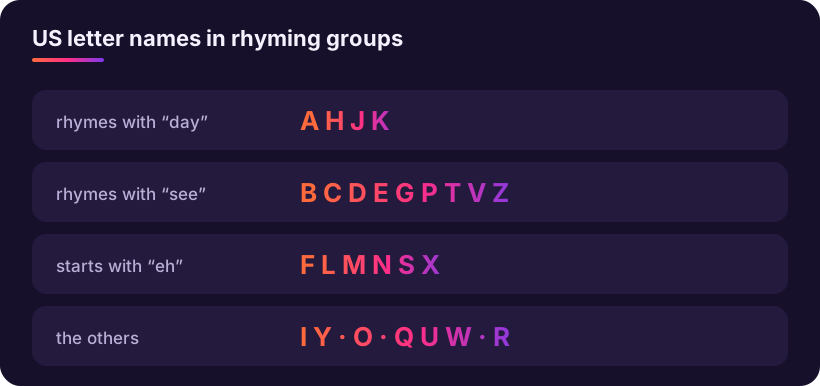
- The "ay" group: A, H, J, K. All have the vowel of eight /eɪt/: A, J and K end in it, and H adds a ch sound.
- The "ee" group: B, C, D, E, G, P, T, V, and Z in American English. All end in the vowel of please /pliz/.
- The "eh" group: F, L, M, N, S, X. Each starts with the vowel of debt and ends in its consonant.
- The odd ones: I and Y share the vowel of eye /ˈaɪ/. O rhymes with go /ˈɡoʊ/. Q, U and W end in the sound of you /ˈju/. R stands alone.
Letter names and letter sounds are different things
A letter's name is what you say when you spell. Its sound is what it does inside a word. C is named "see", but it sounds like k in cat /ˈkæt/ and like s in city /ˈsɪ.ti/. Some letter names even sound like whole words: C like sea /ˈsi/, R like are /ˈɑɹ/, T like tea /ˈti/, and Q like queue /kju/.
When you read IPA in a dictionary, you're reading sounds, not letter names. The pronunciation symbols guide explains that system.
The tricky letters
- G and J swap vowels. G is "jee" (the "ee" group), and J is "jay" (the "ay" group). This is the most common mix-up when spelling aloud.
- E and I. E is "ee", and I is "eye". Many learners whose languages name these letters the other way around mix them up.
- H is "aitch" in American English, with no h sound at the start. Some English speakers elsewhere say "haitch".
- W is "double-u", the only letter name with more than one syllable. Americans often shorten it to "dub-ya" in fast speech.
- R is "ar", like car /ˈkɑɹ/ without the c.
- Y is "why", and Q is "kyoo".
- X is "eks". It starts the x /ɛks/ page in our word list too, because people often look it up.
Zee or zed?
American English says zee. British English, and most of the Commonwealth, says zed. In Canada zed is the usual form, with zee in steady minority use. Play the z /ziː/ page to hear both side by side.
Zee is not an American invention. It was recorded in England in the 1600s. It became the American standard after the late 1700s, when popular American spelling books taught it to generations of schoolchildren.
Spelling a word aloud
- Say each letter clearly, with a small pause. Group long words in threes: "S-I-O, B-H-A, N" for Siobhan /ʃəˈvɔːn/.
- Say double letters as "double". Tell is "T, E, double L".
- Confirm hard letters with a word. "B as in boy" or "M as in Mike" stops B and V, or M and N, from being misheard.
- Spelling alphabets give one fixed word per letter, such as Bravo for B and Mike for M. Pilots, police and call centers use them, and they're worth learning if you spell often on the phone.
Letters said as letters, and letters said as words
Some abbreviations are spelled out letter by letter. AI /ˌeɪ̯ˈaɪ̯/ is "A-I". Others are said as a word: FIFA /ˈfiːfə/ is "FEE-fuh", not four letters, and GIF /ɡɪf/ is said as a word, with an argument about its first sound. When you meet a new abbreviation, check which kind it is before you say it in public.
Practice
Spell your full name, your street, and your email address aloud, slowly, then at normal speed. Record yourself and listen back for G/J and E/I. Then try a few long words from the A–Z word list.
Frequently asked questions
How do you pronounce the letters of the English alphabet?
Learn them in rhyming groups rather than one by one. A, H, J and K share the vowel of eight. B, C, D, E, G, P, T, V and, in American English, Z end in the vowel of please. F, L, M, N, S and X start with the vowel of debt. That leaves I, Y, O, Q, U, W and R to learn on their own, which covers all 26.
How do you pronounce Z in the English alphabet?
In American English it's zee, rhyming with the other "ee" letters. British English, and most of the Commonwealth, says zed, and zed is the usual form in Canada too. Zee is not an American invention: it was recorded in England in the 1600s.
What do the letters in a dictionary pronunciation stand for?
Sounds, not letter names. A dictionary pronunciation shows what you say inside the word, and a letter's sound there can be far from its name: C is named "see", but in a word it can sound like k or s. When the pronunciation is written in IPA, its symbols are sounds too, and the pronunciation symbols guide explains them.
Pronunciations come from our checked word data. The sources are listed on our Credits page.