Guide 07 of 15
English pronunciation for kids: simple, fun ways that work
If your child (or your class) reads English words well on paper but says them in ways nobody understands, correcting every word won't help, since that only makes them go quiet: children learn pronunciation by listening, copying and playing, with lots of repetition and very little pressure. They don't learn it from rules.
Below are mouth cues children can copy, games sorted by grade, word lists to practice, and a ten-minute routine for home or school.
Listen first, then speak
Young learners need to hear a sound many times before they can make it. Read aloud to them every day. Play a word, pause, and let them say it back. Let children listen to the same story or song again and again; repetition is how the sounds settle in.
Speak slowly and clearly yourself, but naturally. Exaggerated, robotic speech teaches the wrong rhythm.
Mouth cues children can copy
Kids copy what they can see. Sit face to face, or use a mirror, and make the shapes together:
| Sound | The cue | Practice word |
|---|---|---|
| th | "Stick your tongue out a tiny bit and blow." | three /θɹiː/ |
| f and v | "Bite your bottom lip gently. For v, make it buzz like a bee." | van /ˈvæn/ |
| w | "Make a little kiss shape, then open." | window /ˈwɪndoʊ/ |
| r | "Pull your tongue back. Don't let it touch anything." | rabbit /ˈɹæ.bət/ |
| l | "Touch the bumpy part behind your top teeth." | lion /ˈlaɪən/ |
| long ee | "Big smile!" | tree /ˈtɹi/ |
| oo | "Round lips, like blowing out a candle." | moon /ˈmun/ |
Touch the throat to feel the difference between a quiet sound and a buzzing one: s is quiet, and z in zebra /ˈziː.bɹə/ buzzes.
Phonics: letters and their sounds
Phonics links each letter, or group of letters, with the sound it makes. Children learn the letter sounds, then blend them: c-a-t becomes cat /ˈkæt/. Teach the sound before the letter name. Once children are spelling words aloud, letter names matter too, and the alphabet guide covers them all.
Clap the syllables
Rhythm matters as much as single sounds. Clap each syllable of a word, and make the strong one a big clap.
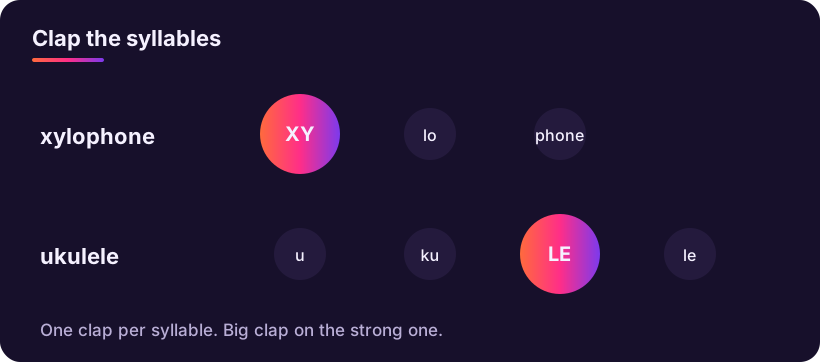
Start with names: everyone in the room claps their own name. Then move to longer words: xylophone /ˈzaɪləˌfoʊn/ is three claps, with the big one first.
Games by grade
Kindergarten to grade 2
- Sound hunt: say a sound, and children find things in the room that start with it.
- Rhyme time: say a word, and children shout a rhyming one.
- Mirror copy: one child makes a mouth shape, and the other guesses the sound.
Grades 3 to 5
- Syllable stomp: stomp each syllable, and jump on the stressed one.
- Minimal-pair grab: put two pictures down, such as a ship and a sheep. Say one word, and children grab the right picture first.
- Tongue twisters: short ones, said slowly first and then faster.
Grades 6 and 7
- Stress detectives: give a list of long words, and students mark the stressed syllable before checking it by listening.
- Record and compare: students record a short reading, then compare it with a model.
- Silent letter challenge: find the letters in a word nobody says.
Word lists by grade
Each word links to its page with audio and IPA.
Early grades
hello /hɛˈloʊ/, four /foɹ/, six /sɪks/, eight /eɪt/, crayon /ˈkɹeɪ̯.ɑn/, water /ˈwɔ.tɚ/, roof /ɹuːf/, bagel /ˈbeɪ̯.ɡəl/
Middle grades
ukulele /juː.kəˈleɪ.li/, jaguar /ˈd͡ʒæɡ.wɑɹ/, library /ˈlaɪˌbɹɛɹ.i/, February /ˈfɛb.ɹuˌɛɹi/, syrup /ˈsɪɹ.əp/, opossum /əˈpɑsəm/
Upper grades
mischievous /ˈmɪs.tʃə.vəs/, hyperbole /haɪˈpɝbəli/, onomatopoeia /ˌɑnəˌmætəˈpiːə/, archipelago /ˌɑɹkəˈpɛləˌɡoʊ/, hierarchy /ˈhaɪ.ɹɑː(ɹ).ki/, epitome /ɪˈpɪt.ə.mi/
A ten-minute routine for parents and teachers
| Minutes | Activity |
|---|---|
| 0–2 | Read one short rhyme aloud while the child listens. |
| 2–4 | Read it again, with the child joining in. |
| 4–6 | Mouth cues: two sounds from the table, five times each. |
| 6–8 | One game from their grade. |
| 8–10 | Three words from their list: play, repeat, clap the syllables. |
Tips for correcting gently
- Repeat the word correctly instead of saying "no". If a child says "free" for three, answer "Yes, three!" with the right sound.
- Correct one sound at a time. Pick the sound that matters most, and leave the rest for another day.
- Praise effort, not just results. Children who feel confident speak more, and speaking more is how they improve.
- Be patient. Some sounds, like r and th, can take months. That is normal.
Frequently asked questions
When should children start learning English pronunciation?
As early as they start hearing English. Young children pick up sounds easily, but older children and adults improve too, with practice.
Should kids learn American or British English?
Either, as long as you stay consistent. This site puts American English first. Many word pages also show the British form, and on any word page you can switch the voice to British English.
What if my own English pronunciation isn't perfect?
Use recorded audio as the model, and learn alongside your child. Playing the word in the pronunciation tool gives you both the same target.
What English pronunciation words are good for kids?
Start with short words they already use every day, such as hello, four, six and water. As they move up through school, add longer words like library and February, and keep the hardest ones, such as mischievous and onomatopoeia, for the upper grades. The word lists above are sorted that way, and every word in them has its own page with audio.
Pronunciations come from our checked word data. The sources are listed on our Credits page.