Guide 10 of 15
Pronunciation guides in books: what they are and how to read them
You've been saying a fantasy hero's name in your head for 300 pages, the pronunciation guide at the back of the book says you got it wrong, and the fix is easy, because these guides follow three simple conventions: hyphens split the syllables, capitals mark the stressed one, and familiar words show the sounds. Many authors include a guide because they know their invented names don't follow ordinary spelling.
Below, each convention gets its own short section, followed by when to trust the author's key and what to do when a book has none.
What a book's pronunciation guide is
Authors use a few formats:
- A pronunciation list at the front or back, giving each invented name a respelling.
- A glossary of names, places and invented words, each with its meaning and pronunciation.
- An audio guide on the author's or publisher's website, where you can hear the names spoken.
- A note to the audiobook narrator, sometimes shared with readers later.
Most of these use respelling, writing the sounds with ordinary letters, rather than the phonetic symbols of a dictionary.
How to read a respelling key
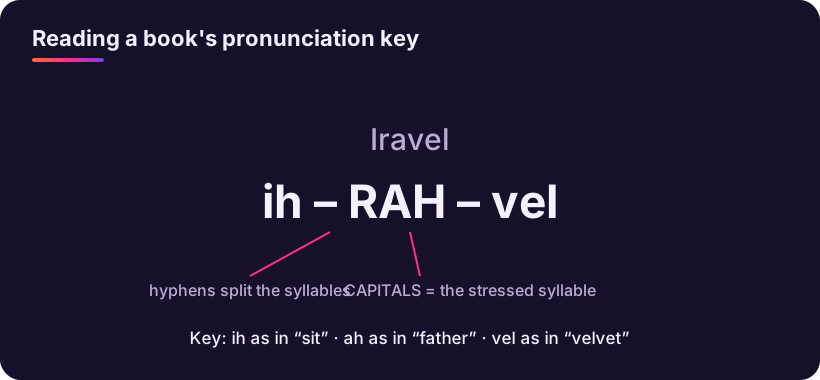
Hyphens split the syllables
ih-RAH-vel has three syllables: ih, rah and vel.
Capitals or bold mark the stress
The syllable in capitals is the strong one. In ih-RAH-vel, the beat falls on RAH.
Key words show the sounds
A good guide starts with a short key, such as "ah as in father, ay as in day, th as in thin". Use the key, not your instinct. Respelling systems differ from book to book, and ai might mean the vowel of eye in one book and of day in another.
When the guide uses IPA
Some books, especially those with constructed languages, use phonetic symbols instead. The pronunciation symbols guide shows how to read them.
Why invented names get mispronounced
Writers often build names from real languages, and those languages spell sounds differently from English. Irish names are the classic case: Siobhan /ʃəˈvɔːn/, Saoirse /ˈsɪɚ.ʃə/, Niamh /ˈniv/ and Aoife /ˈi.fə/ look nothing like their sounds to an English reader. Names from myth carry traps of their own: Persephone /pɚˈsɛfəniː/ has four syllables, and Hecate /ˈhɛkəti/ usually has three in American English.
Readers fall back on English spelling rules. If an author wants a name said a particular way, a guide is the only reliable way to say so.
Names readers often get wrong
Many names in fiction come from myth, history and Irish or Welsh tradition. These real names turn up again and again, and each links to its page with audio:
| Name | Where it comes from |
|---|---|
| Circe /ˈsɝ.si/ | Greek myth |
| Eurydice /jʊəˈɹɪdɪsi/ | Greek myth |
| Telemachus /təˈlɛməkəs/ | Greek myth |
| Yggdrasil /ˈɪɡdɹəsɪl/ | Norse myth |
| Maeve /meɪv/ | Irish tradition |
| Xerxes /ˈzɝksiːz/ | Persian history |
| wyvern /ˈwaɪvəɹn/ | heraldry and fantasy |
Names from the Bible
Bible names turn up in novels, plays and poems, and many of them are long and unfamiliar. These are on our word pages, each with audio:
| Name | Who or what |
|---|---|
| Zechariah /ˌzɛkəˈɹaɪ.ə/ | a prophet, and the book named after him |
| Zephaniah /zɛfəˈnaɪə/ | a prophet, and a short book of the Old Testament |
| Isaiah /aɪˈzeɪ.ə/ | a prophet, and a book of the Old Testament |
| Habakkuk /həˈbæk.ək/ | one of the minor prophets |
| Elisha /ɪˈlaɪʃə/ | a prophet who followed Elijah |
| Deborah /ˈdɛ.bɚ.ə/ | a prophetess and judge of Israel |
| Melchizedek /mɛlˈkɪzədɛk/ | a king and priest in Genesis |
| Nebuchadnezzar /ˌnɛbəkədˈnɛzɚ/ | a king of Babylon |
| Ecclesiastes /ɪˌkliːziˈæstiːz/ | a book of the Old Testament |
Read their respellings the same way as a book's key: say one syllable at a time, then put the weight on the part in capitals. Two habits help with these names. A ch is often a k, as in Zechariah, ze-kuh-RIGH-uh, and Melchizedek, mel-KIZ-uh-dek. Names ending in -iah usually put the beat on the igh, as in Zephaniah, ze-fuh-NIGH-uh. When you're not sure, play the name slowly and copy it.
Whose pronunciation is right?
For a name the author invented, the author's guide is the best answer, because the name only exists in their book. For a real name or word, a dictionary is the better guide. Some authors say openly that readers may say names however they like. Others give a guide and expect it to be followed. Audiobook narrators usually follow the author's guide, so the audiobook is often the quickest way to hear the intended sound.
When a book has no guide
- Check the author's website. Many authors post a name list or audio file there.
- Listen to an audiobook sample, or an interview where the author says the names.
- Look the name up. If it's a real name, like Dionysus /daɪ.əˈnaɪ.səs/, our word pages have it with audio.
- Pick one way and stay consistent. Reading is private, and a consistent guess is better than three different ones.
For writers: making a guide readers will use
- Keep the respelling simple and consistent: hyphens for syllables, capitals for stress.
- Open the guide with a five-line key showing the sounds you use.
- Respell names against common words, not against other invented names.
- Put the guide where readers will find it early, and mention it at the start of the book.
- If you can, record the names and post the audio online.
Readers who aren't sure about any word can try it in the pronunciation tool first.
Frequently asked questions
What is a pronunciation guide in a book?
It's a list, usually at the front or back of a novel, that tells you how to say the invented names and words in the story. Most give each name a respelling in ordinary letters. Some come as a glossary with meanings too, and some authors post an audio version online.
How do you read a pronunciation guide in a book?
Keep three conventions in mind. Hyphens split the syllables, the syllable in capitals or bold carries the stress, and the key at the top tells you which sound each spelling stands for. Trust the key over your instinct, because respelling systems differ from book to book.
Why do fantasy books have pronunciation guides?
Because invented names are often built from real languages that spell sounds differently from English, and readers fall back on English spelling rules. A guide is the only reliable way for an author to say how a name should sound.
Do book pronunciation guides use IPA?
Most don't. They use respelling, which writes the sounds with ordinary letters. Some books, especially those with constructed languages, use the phonetic symbols of a dictionary instead.
Where can you find the pronunciation guide for a book series?
Look at the front and back of each book first. If there's nothing there, check the author's website, where many authors post a name list or an audio file, or listen to an audiobook sample, because narrators usually follow the author's guide.
How do you pronounce Bible names?
Look the name up and read its respelling: hyphens split the syllables, and the part in capitals carries the stress. In many of these names ch is said k, as in Zechariah and Melchizedek, and names ending in -iah usually stress the igh, as in Zephaniah.
Pronunciations come from our checked word data. The sources are listed on our Credits page.