
Guide 12 of 15
How to pronounce difficult words: the hard ones, and how to crack them
When a word's spelling doesn't tell you how to say it, the way in is to work out which kind of hard word it is, because each kind has its own fix. Some hide letters they never say, others came into English from another language and kept their own sounds, and a few are just long.
This guide groups the difficult words people look up most into five kinds. Each word has its American pronunciation and a Play button, and each kind ends with a way to practice it.
Words that hide their letters
Some spellings hold letters that are never said. The only way to learn these words is as whole words, by ear.
- Worcestershire /ˈwʊstɚʃɚ/ is said WUU-stur-shur. Most of the letters in the middle are silent.
- Edinburgh /ˈɛd.ənˌbɝ.oʊ/ is said ED-uhn-bur-oh. The ending -burgh sounds nothing like burg.
- Samhain /ˈsaʊ.wən/ is said SOW-wuhn. The mh makes a w sound.
Practice: say the word slowly from its sound breakdown, not from its spelling. Look away from the letters while you say it.
Words borrowed from other languages
Food words especially keep the sounds of the language they came from. English spelling rules don't apply to them.
| Word | Say it |
|---|---|
| quinoa /ˈkin.wɑ/ | KEEN-wah |
| gnocchi /ˈnjoʊ.ki/ | NYOH-kee, with a silent g |
| bruschetta /bɹuˈskɛtə/ | broo-SKET-uh: the sch is said sk |
| chipotle /t͡ʃɪˈpoʊt.leɪ/ | chi-POHT-lay |
| charcuterie /ʃɑɹˈkutəɹi/ | shahr-KOO-tuh-ree |
| focaccia /foʊˈkɑtʃə/ | foh-KAH-chuh |
| acai /ɑ.sɑˈi/ | ah-sah-EE, three syllables |
| gyoza /ˈɡjoʊzə/ | GYOH-zuh |
Famous names catch people out for the same reason: readers say them by English spelling rules. Brand names such as Porsche /ˈpɔɹʃ/ and Hyundai /ˈh(j)ʌn.deɪ/ are often said wrong, and people's names trip readers up too, like the philosopher Nietzsche /ˈniː.t͡ʃə/ and the painter Van Gogh /vænˈɡoʊ/.
Practice: learn the sound pattern behind the word. Once you know that the cch in gnocchi is a k and the cci in focaccia is a ch, the next menu gets easier.
Words with a well-known wrong version
Some words have a version so common that dictionaries record it, and mark it as wrong or nonstandard. Each of these word pages has a "Common mistakes" section that shows the wrong form.
- Oregon /ˈɔɹɪɡən/ is AWR-i-guhn. The last syllable is weak, not gone.
- turmeric /ˈtɝ.mɚ.ɪk/ is TUR-mur-ik. Say the first r.
- sherbet /ˈʃɝ.bət/ is SHUR-buht, with no second r.
- biopic /ˈbaɪ.oʊ.pɪk/ is BIGH-oh-pik, three syllables, with the stress at the start.
- wagyu /ˈwæɡ.juː/ is WAG-yoo. Keep the y sound.
Practice: say the right version and the wrong one side by side, so you can hear the difference, then say the right one three times.
Long words
A long word is just a row of short syllables. Find the stressed one, then say the word in parts.
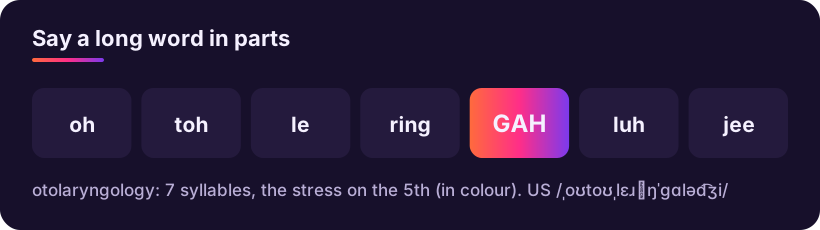
- otolaryngology /ˌoʊtoʊˌlɛɹɪŋˈɡɑləd͡ʒi/: oh-toh-le-ring-GAH-luh-jee, seven syllables.
- rhabdomyolysis /ˌɹæb.doʊ.maɪˈɑl.əs.ɪs/: rab-doh-migh-AHL-uhs-is, six syllables.
- pneumonoultramicroscopicsilicovolcanoconiosis /nuˈmɑ.noʊˌʌl.tɹə.maɪ.kɹoʊˈskɑ.pɪkˈsɪ.lɪ.koʊ.vɑlˌkeɪ.noʊ.koʊ.niˈoʊ.sɪs/: 45 letters and 19 syllables, and it is best known as one of the longest words in English. To say it, take it in parts, and slow the voice down to hear each one.
Practice: say the parts one at a time, then two together, then the whole word. Put the most weight on the stressed part.
Place names
Place names often keep an older or local pronunciation that the spelling doesn't show.
- Nevada /nɪˈvædə/: ni-VAD-uh. The middle vowel is the a of cat.
- Arkansas /ˈɑɹkənˌsɔ/: AHR-kuhn-saw. It doesn't rhyme with Kansas, and the final s is silent.
- Qatar /ˈkɑtɚ/: KAH-tur.
Practice: listen to the word several times before you say it, because place names follow local habit, not rules.
A routine for any difficult word
- Play the word and listen without reading it.
- Read the sound breakdown, and find the stressed part in capitals.
- Slow the voice down with the speed control, and play it again.
- Say it yourself with the practice recorder on the word page, and compare.
- Come back tomorrow. A word you can say after a night's sleep is a word you've learned.
Words spelled the same but said two ways
Some spellings stand for two different words. These are called heteronyms. The sentence tells you which word you have, so read to its end before you say the word.
Many of them follow one pattern. In a two-syllable word that is both a noun and a verb, the noun puts the stress on the first syllable, and the verb puts it on the second.
| Word | Noun | Verb |
|---|---|---|
| record /ɹəˈkɔɹd/ | /ˈɹɛkɚd/, a best result or a music disc | /ɹɪˈkɔɹd/, to save sound or facts |
| present /ˈpɹɛ.zənt/ | /ˈpɹɛzənt/, a gift | /pɹɪˈzɛnt/, to give or show |
| object /ˈɑb.dʒɛkt/ | /ˈɑbdʒɛkt/, a thing | /əbˈdʒɛkt/, to disagree |
| desert /ˈdɛ.zɚt/ | /ˈdɛzɚt/, dry land | /dɪˈzɝt/, to leave |
Others change a vowel or a consonant instead of the stress:
- read /ˈɹɛd/ is /ɹid/ today and /ɹɛd/ yesterday.
- lead /ˈlɛd/ is /lid/ when it means to guide, and /lɛd/ when it is the metal.
- wind /ˈwaɪnd/ is /wɪnd/ when it blows, and /waɪnd/ when you turn a key.
- tear /ˈtɛɹ/ is /tɪɹ/ from your eye, and /tɛɹ/ when you rip paper.
- live /ˈlaɪv/ is /lɪv/ as a verb, and /laɪv/ in live music.
- close /ˈkloʊs/ ends in a z sound when it means to shut, and an s sound when it means near.
Practice: a Play button can give only one of the two, so read the symbols for both. Then say each word in a short sentence, such as I want to record a record.
Frequently asked questions
Why is Worcestershire pronounced like that?
The spelling kept an old ending that speech wore down long ago. Worcester grew from an Old English name ending in the word for a Roman fort, and of the written -cester only the -ster part is said. The short form is centuries old: Shakespeare's verse already seems to treat names like it as two syllables. How and when it shrank isn't known for certain. The -shire at the end is said lightly, like shur.
What famous names are constantly mispronounced?
Names from other languages, because people read them by English spelling rules. Brand names are a big group, and Porsche and Hyundai are two that many people get wrong. People's names catch readers out the same way, such as Nietzsche and Van Gogh. Each of these has its own word page with audio.
What words do people stumble on most?
Mostly five kinds: words that hide their letters, like Worcestershire; words borrowed from other languages, like quinoa and gnocchi; words with a well-known wrong version; long words, like otolaryngology; and place names, like Arkansas. The fix is much the same for all of them: listen first, find the stressed part, and say the word in pieces.
What words do people still pronounce incorrectly?
The words with a well-known wrong version: Oregon, where the last syllable is weak, not gone; turmeric, where the first r is said; sherbet, which has no second r; biopic, which has three syllables; and wagyu, which keeps its y sound. The wrong versions are common enough that dictionaries record them, and mark them as wrong or nonstandard.
What is a heteronym?
A heteronym is a word spelled the same as another word but said differently, with a different meaning, like lead the metal and lead, to guide. Many two-syllable heteronyms follow one pattern: the noun stresses the first syllable and the verb the second, as in a REcord and to reCORD.
Pronunciations come from our checked word data. The sources are listed on our Credits page.