Guide 11 of 15
American vs British pronunciation: the differences that matter
American and British English share almost all their words but not always their sounds, and most of the differences you hear come from a short list of patterns: the r after a vowel, three vowels, the t between vowels, and a few words that change a sound or their stress. Learn those patterns, and you can hear at once which accent a speaker is using, and switch between the two yourself.
This guide covers each pattern with real words from this site. For every word you get the American form, with a Play button, and the British form beside it. Many word pages show both, US first and UK second. A page with no British line has no sourced British form.
Some differences are only in the spelling. cancelled /ˈkæn.səld/ sounds the same written with one l or two: American English usually writes canceled, British English writes cancelled, and both spellings are accepted in the US.
The r after a vowel
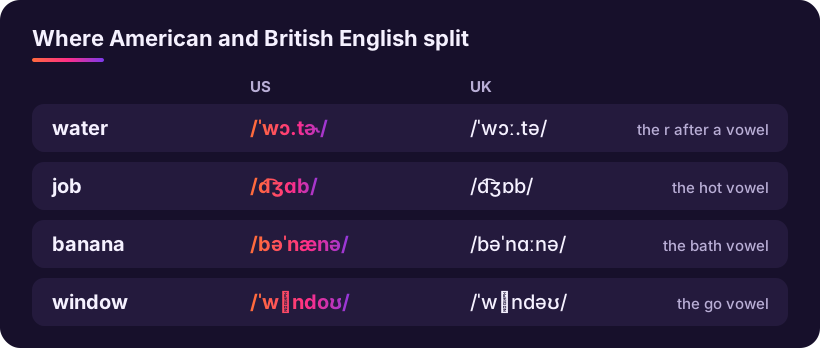
This is the biggest difference. American English says every written r, even after a vowel at the end of a syllable. Standard British English drops that r and lengthens or changes the vowel before it.
| Word | British form |
|---|---|
| water /ˈwɔ.tɚ/ | /ˈwɔː.tə/ |
| garden /ˈɡɑɹ.d(ə)n/ | /ˈɡɑː.d(ə)n/ |
| market /ˈmɑɹkɪt/ | /ˈmɑːkɪt/ |
| doctor /ˈdɑktɚ/ | /ˈdɒktə/ |
An r before a vowel is said in both accents: the r in red never changes. British speakers also say a final r when the next word starts with a vowel, as in water ice.
The r can change the vowel in front of it, too. For most Americans, Mary /ˈmɛ.ɹi/, marry /ˈmɛ.ɹi/ and merry /ˈmɛ.ɹi/ all sound the same: play them one after another and listen. Standard Southern British English keeps three different vowels there. Mary has the long vowel of hair, marry has the a of cat, and merry has the e of bed. Outside North America, saying all three alike is rare.
The "hot" vowel
In words like hot, American English uses an open ah sound, written ɑ. British English uses a short rounded vowel, written ɒ, made with the lips slightly round.
| Word | British form |
|---|---|
| job /d͡ʒɑb/ | /d͡ʒɒb/ |
| hospital /ˈhɑs.pɪ.tl̩/ | /ˈhɒs.pɪ.tl̩/ |
| odyssey /ˈɑ.dɪ.si/ | /ˈɒd.ɪ.si/ |
| genre /ˈ(d)ʒɑnɹə/ | /ˈ(d)ʒɒnɹə/ |
The "bath" vowel
In a group of words like bath, American English keeps the short a of cat, written æ. Southern British English uses a long ah, written ɑː. It is only a group, though: cat keeps its short a in British English too, and most of northern England says bath with the short a.
| Word | British form |
|---|---|
| aunt [ænt] | [ɑːnt] |
| banana /bəˈnænə/ | /bəˈnɑːnə/ |
| examples /ɪɡˈzæmpl̩z/ | /ɪɡˈzɑːmpl̩z/ |
| draught /dɹæft/ | /dɹɑːft/ |
The "go" vowel
The vowel in go starts further back in American English, written oʊ. In British English it starts in the middle of the mouth, written əʊ. It's a small difference, but you hear it in almost every sentence.
Words that change a whole sound
Some words don't follow a pattern. One accent simply uses a different sound in one place, and you learn these one at a time.
| Word | British form | What changes |
|---|---|---|
| tomato /təˈmeɪ.toʊ/ | /təˈmɑː.təʊ/ | may in American, mah in British |
| data /ˈdeɪtə/ | /ˈdɑːtə/ | day in American, dah in British |
| basil /ˈbeɪ.zəl/ | /ˈbæz.əl/ | bay in American, the a of cat in British |
| niche /nɪt͡ʃ/ | /niːʃ/ | rhymes with itch in American, ends eesh in British |
| vase /veɪ̯s/ | /vɑːz/ | vays in American, vahz in British |
| lieutenant /l(j)uˈtɛn.ənt/ | /lɛfˈtɛn.ənt/ | British English says lef- at the start |
| z /ziː/ | /zɛd/ | the letter is zee in American and zed in British |
| aluminum /əˈlu.mɪ.nəm/ | /ˌæl.(j)ʊˈmɪn.jəm/ | British English spells it aluminium, and says the extra syllable |
Words that move their stress or lose a syllable
A few words put the stress on a different syllable, or have a different number of syllables.
| Word | British form | What changes |
|---|---|---|
| Kazakhstan /ˈkɑzəkˌstæn/ | /ˌkæzəkˈstɑːn/ | stress at the start in American, at the end in British |
| quinine /ˈkwaɪ.naɪn/ | /kwɪˈniːn/ | stress on the first syllable in American, the second in British |
| library /ˈlaɪˌbɹɛɹ.i/ | /ˈlaɪ.bɹi/ | three syllables in American, two in British |
| caramel /ˈkɑɹməl/ | /ˈkæɹəˌmɛl/ | two syllables in our American form, three in British |
The t between vowels
Between two vowels, American English often softens t into a quick tap, close to a light d. British English keeps a clear t. You can see it in British [ˈbɹɪɾɪʃ] itself: British English has [ˈbɹɪtɪʃ] with a full t.
The t in important /ɪmˈpɔɹ.tənt/ changes for a related reason. It comes just before a last syllable that is little more than an n, and American English often says a t in that spot as a catch in the throat, a glottal stop, instead of a full t. Some younger speakers use the quick tap there instead. Nobody is failing to say the letter: it is a regular habit of the accent, heard more in the western US and among younger speakers, and many British speakers do the same in button.
Which one should you learn?
Learn the one you hear most, and stay consistent. Both are correct, and both are understood everywhere. This site is built for American English, so it shows American first. Many word pages also give the British form, and on any word page you can switch the voice to British English and play the word again.
What about other accents?
English has many more accents than these two. Australian, Irish, Scottish and Indian English, and many others, each have their own sounds, and none of them is wrong.
This site gives American English first. Where we have a British form on file, the word page shows it second. We don't have checked forms for other accents, so this guide doesn't describe them. If you need one of them, listen to speakers from that place, and use the same method as this guide: find the few patterns that change, and learn them one at a time.
Frequently asked questions
Why can't people pronounce the t in important?
They can: the t changes by habit, not by mistake. In important the t comes just before a last syllable that is little more than an n, and American English often says a t there as a catch in the throat, a glottal stop. Some younger speakers use a quick tap instead. Many British speakers do the same thing in button.
Why are Mary, marry and merry the same in the US but not the UK?
Before an r, most American speakers have merged three vowels into one, so the three words sound alike. Standard Southern British English keeps them apart: Mary has the vowel of hair, marry the a of cat, and merry the e of bed. Saying all three the same way is rare outside North America.
What are common mistakes when trying to sound British?
Most slips come from pushing a pattern further than British speakers do. Dropping every r is one: British English still says an r before a vowel, as in red, and across two words, as in water ice. Giving every a the long ah is another, because cat keeps its short a, and most of northern England says bath with the short a too. Keeping the quick American tap for the t in words like water also gives the accent away.
How is cancelled pronounced in American English, and why two ways?
It sounds the same however you spell it: two syllables, with the stress on the first. The two ways are spellings. American spelling usually doesn't double the l when the stress isn't on the last syllable, so it writes canceled, while British spelling writes cancelled. Both spellings are accepted in the US.
Which letter is silent in RP?
The r after a vowel. Standard British pronunciation drops a written r at the end of a syllable, as in water and garden, and lengthens or changes the vowel before it instead. An r before a vowel is still said.
What English words do Americans and the British pronounce differently?
Most of the differences follow patterns, so whole groups of words change together: words with an r after a vowel, and words with the hot, bath and go vowels. Others change one at a time, such as tomato, data, vase and the letter z, and a few move their stress or lose a syllable, like library.
Does this site show Australian or Indian pronunciation?
No. Word pages give American English first, and British English where we have it on file. Australian, Indian and other accents differ from both, so for those, listen to speakers from that place.
Pronunciations come from our checked word data. The sources are listed on our Credits page.